
The Peer Supported Open Dialogue approach, recently the subject of the largest randomised controlled trial in mental health across NHS England, represents an innovative and progressive model with the potential to fundamentally transform mental health services. Originating in Finland in the 1980s, this holistic, person-centred, recovery-oriented approach actively involves individuals alongside their families and social networks. Strikingly continuity of care and shared decision making are core to this model and therefore enable a level of agency and relational engagement few have experienced in services.
More information about this approach can be found below:
Open Dialogue, explained FULL EPISODE with Mark Hopfenbeck February 2026
Open Dialogue Network Meetings: WHY They Work Dr Gareth Jarvis January 2026
Financial Times Article featuring Chair Rachel Bannister and Patron Professor Russell Razzaque 1st January 2026
Open Dialogue is transforming mental health care in Australia October 2025
Introduction to Open Dialogue Dr Gareth Jarvis
Is Dialogue the Best Medicine? A Conversation With Jaakko Seikkula 30 July 2025
Open Dialogue in action in Torbay Devon
A suitable manner? Seven key elements of a dialogical approach to the Mental Health Act Assessment
21 May 2025
Developing an Open Dialogue inspired model of systemic social work assessment in a local authority children’s social care department Martin Clement Richard Mc Kenny July 2019
Some of the things that excite me about Open Dialogue by Rachel Waddingham
‘DEVELOPING OPEN DIALOGUE (DoD) has been created from a passion to find different ways of understanding mental health difficulties. Open Dialogue is a social network approach to mental health difficulties, involving family members, friends and others who are concerned. It was developed in Tornio, Western Lapland, Finland by Jaakko Seikkula and colleagues in the early 1980’s. Click here to read more about Finnish Open Dialogue.’
Open Dialogue around the world – implementation, outcomes, experiences, and perspectives 5 June 2025
Open Dialogue: A New Approach to Mental Healthcare Guest blog by British psychiatrist Dr. Tom Stockmann.
What people say about Peer-supported Open Dialogue (POD)
Conceptualizing the peer contribution in Open Dialogue practice August 2023 Corrine Hendy, Jerry Tew and Sarah Carr
Developing Open Dialogue “For the word (and consequently for the human being) there is nothing more terrible than a lack of response” – Mikhail Bakhtin
Peer-supported Open Dialogue (POD) in NHS mental health services Kent and Medway NHS and Social Care Partnership Trust
Evaluating Open Dialogue in Italian mental health services: evidence from a multisite prospective cohort study September 2024
Open Dialogue in the UK – Professor Russell Razzaque Sky News
ODDESSI (Randomised Controlled Trial)
ODDESSI (Open Dialogue: Development and Evaluation of a Social Network Intervention for Severe Mental Illness) is a large-scale programme of research into crisis and continuing mental health care within the NHS. This programme is directed by Professor Stephen Pilling (UCL), funded by the National Institute of Health Research (NIHR) and managed by North East London NHS Foundation Trust (NELFT) and includes Open Dialogue and research teams in five NHS Trust research sites:
Podcast series on Peer Supported Open Dialogue
‘Explaining what Peer Supported Open Dialogue actually entails can be challenging. Talking about talking in order to explain the content of a network meeting is like trying to hold smoke, as Amanda puts it. In this series we hope to record conversations that are dialogical and form a dialogue, with insights from creators, practitioners and teachers of Open Dialogue. We would love it if we could form a dialogue with you. We would like to quite literally demystify what Open Dialogue is all about by having a dialogue about it.’
Open POD pod
Find out more here.
Open Dialogue Centre Australia
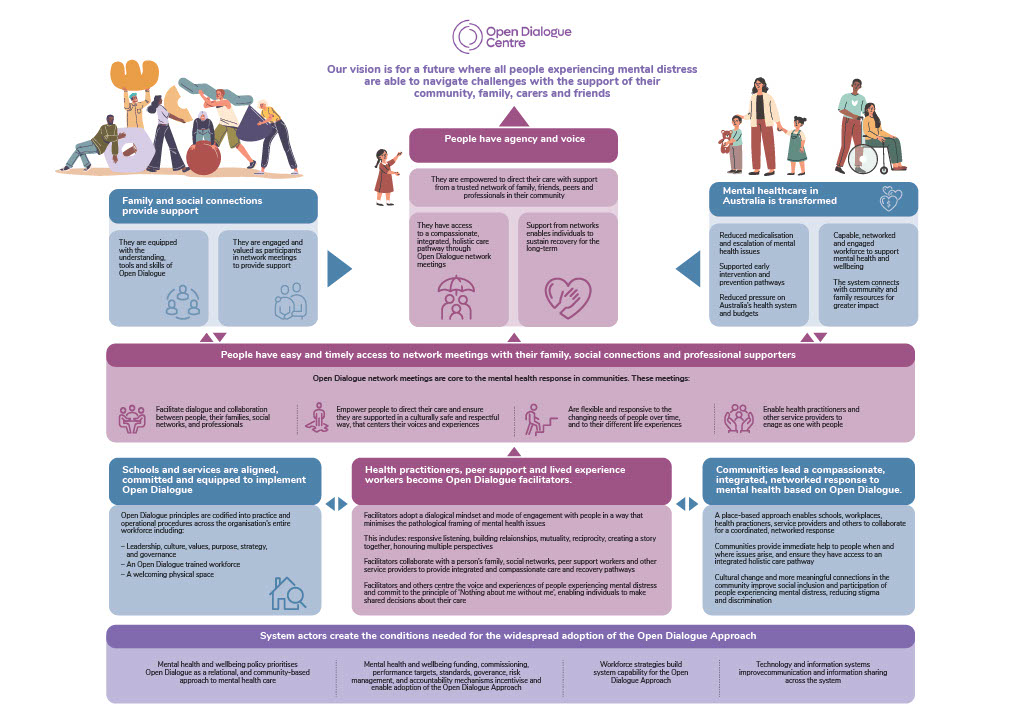
‘Our purpose is to enable the widespread adoption of Open Dialogue in Australia.
Our vision is that all people experiencing mental distress are able to navigate challenges with the support of their community, family, carers and friends. From the international evidence, we know that Open Dialogue has the potential to be transformative.’
29th International Meeting on Dialogical Treatment of Psychosis
The event, dedicated to “40 years of experience in Open Dialogue in Western Lapland,” will provide a platform to discuss the dialogical approach to the treatment of psychosis, as well as the current state and future of Open Dialogue and Dialogical Practice both in Lapland and around the world.
Practitioners, researchers, students, service users, people with lived experiences, relatives, peers, and all others interested are welcome. The meeting will be held in English, with the exception of the Open Day, which will be partly in Finnish. Simultaneous interpretation into English will be provided.
For more information, visit the website: https://lapinamk.fi/en/Event/29th-international-meeting/
Wild Truth Healing from Childhood Trauma
In the far north of Finland, a stone’s throw from the Arctic Circle, a group of innovative family therapists converted the area’s traditional mental health system, which once boasted some of Europe’s poorest outcomes for schizophrenia, into one that now gets the best statistical results in the world for first-break psychosis. They call their approach Open Dialogue. Read more here.
‘Open dialogue to tackle mental distress‘
Open dialogue should engage family, friends, relatives and the networking system in discussion in the crisis of a person, and their different point of views should be taken into account,” said Professor David Mosse
‘Open dialogue is an opportunity for post-psychiatry evolution not anti-psychiatry revolution’
There’s a real ‘sea change’ in the air as services crumble under ongoing austerity measures and increasing caseloads, writes mental health social worker Ash Holderness.
‘Open dialogue means there is no single truth and no manual’
Mental health social worker Ash Holderness argues we must drop our obsession with a one-size fits all approach to mental health.
‘Open Dialogue: The radical new treatment having life-changing effects on people’s mental health’
The pioneering approach enables patients like Suzanne Chapman and their families to develop their own route to recovery.
 Mental Health - Time for Action Foundation